Winter
Dormant pruning; structure is easy to see.
Invasive tree removal
Few yard trees cause as much trouble for their size as a Bradford pear. Callery pear, sold for decades as Bradford, Cleveland Select, Aristocrat and Autumn Blaze, is an invasive tree that splits easily in wind and ice and spreads into thorny thickets. Removing it means cutting the tree and treating the stump right away, or the stump sends up wild sprouts. Missouri has banned its sale starting January 1, 2029, but owners are not required to remove trees they already have, and the Missouri Department of Conservation recommends native replacements such as serviceberry and redbud.
 Greene & Christian County
The Missouri Department of Conservation says Callery pear is native to China and was brought to the United States in 1917 to help breed disease resistance into fruiting pears. The Bradford cultivar became a popular street and yard tree, and many other cultivars followed. Each one alone was thought to be sterile, but different cultivars planted near one another cross-pollinate and set viable seed, which birds spread.
Escaped trees form dense thickets along roadsides, old fields and woodland edges, leaf out earlier than native trees and shade out spring wildflowers. Wild trees and sprouts carry long thorns. The Conservation Department lists the species as present statewide, and the thickets are easiest to spot in early spring when they are white with bloom.
Field note
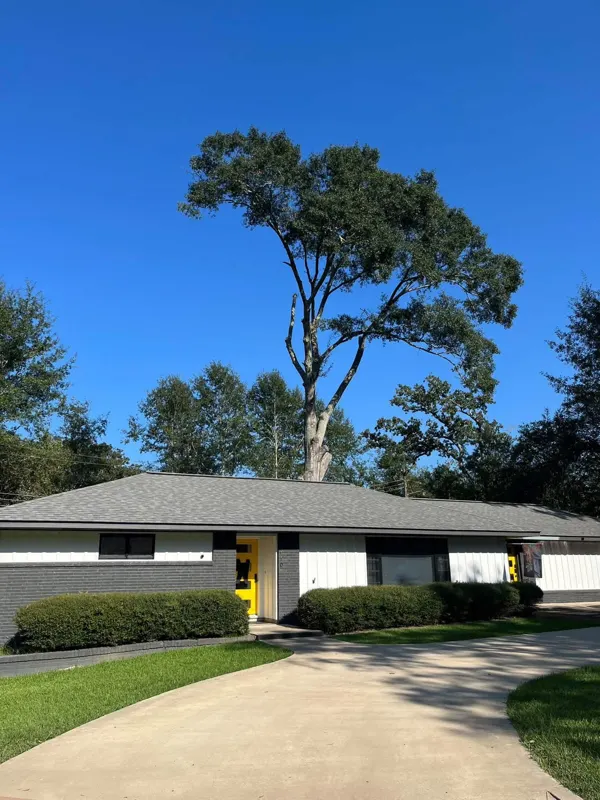
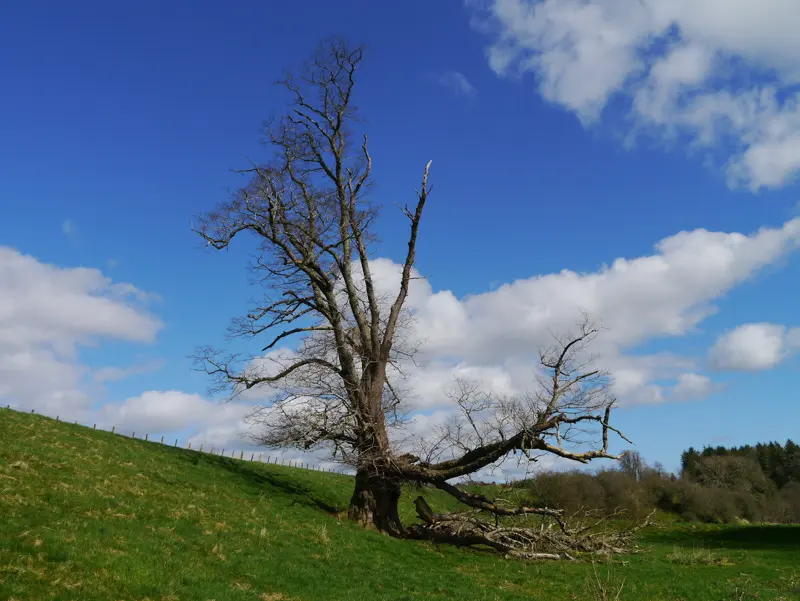
MDC notes that Callery pear grows quickly but dies young and often breaks in strong winds. The Bradford form in particular grows heavy limbs with narrow branch unions that can split under ice or wind. A mature tree with that structure can lose a major limb in one storm, and when it stands over a roof, fence or driveway the damage adds up quickly.
Splitting usually starts where several upright limbs leave the trunk at the same point. Look for a seam or crack running down from that junction, bark folded into the union, or a lean that has appeared after a storm. Our article on storm damage to Ozarks trees explains what to do when a limb has already failed.
Governor Mike Kehoe signed Senate Bill 105 on July 14, 2025. It halts the sale in Missouri of six invasive plants, and the deadlines are staggered: four of them may be sold through January 1, 2027, while Callery pear and burning bush may be sold until January 1, 2029. After that date nurseries cannot sell Callery pear in the state.
The law targets sales. It does not require a homeowner to cut down a tree that is already growing. The Missouri Invasive Plant Council runs a yearly Pear Buyback with MDC and other partners, where registered owners who send a photo of a cut Callery pear receive one free native tree.
Springfield was a pickup location in 2026, and that year's registration has closed.
Small seedlings can be pulled when the soil is moist, as long as the whole root comes out. Larger trees are cut, and MDC advises treating the stump immediately with a 25 to 50 percent solution of glyphosate or triclopyr, because untreated stumps send up vigorous sprouts that grow into the thorny wild form.
On trees up to six inches across, a basal bark treatment of triclopyr ester in oil applied in a 12-inch band around the base is another MDC option. Always follow the product label.
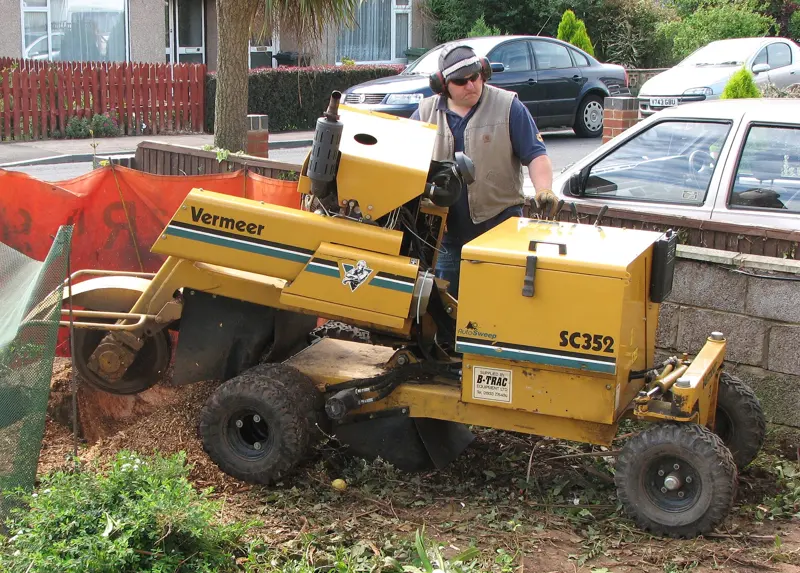
In a yard, the work is mostly about control. A splitting pear near a house is taken down in sections with ropes so limbs land where they should. After the stump is treated, stump grinding removes what is left above ground and lets you replant nearby.
See our tree removal service and the tree removal cost guide for what affects the price.
MDC says herbicide uptake works best in late winter to early spring or during summer, and that mature trees can be girdled in spring and summer by cutting through the bark all the way around the trunk six inches above the ground. Girdled trees die standing, which is fine in a field but not beside a driveway, so in yards we usually cut and treat.
Removing a tree before spring bloom also means you do not add another season of seed. If a storm has already split the tree, safety comes first and the stump can be treated as soon as the trunk is down.
MDC suggests replacing Callery pear with native small trees such as serviceberry, yellowwood, redbud and hornbeam, and its control guide also names American plum, flowering dogwood and hawthorn. Serviceberry gives a similar white spring bloom. The 2026 Springfield buyback list included redbud, blackgum, red maple, swamp white oak, Ohio buckeye and pawpaw among others.
Plant the new tree where the old pear's roots will not get in the way and where it has room at full size. If you are planting near the street, Springfield requires a permit from the Director of Public Works for street trees. Our tree planting team can help choose and place it.
Missouri Department of Conservation, Callery Pear Control (history, spread, cutting, stump and basal bark treatment, timing, girdling) and Callery Pear (Bradford Pear) field guide (branch failure, sprouts, native replacements). Missouri Invasive Plant Council, Governor Kehoe Signs Missouri Invasive Plant Bill into Law and Pear Buyback.
Jefferson City News Tribune, Missouri bans sale of Callery pear trees (2029 date for Callery pear). City of Springfield, Code of Ordinances, Chapter 114 (street tree permits).
Why trust us
Springfield, Nixa, Ozark, Republic and the towns between.
What comes down, how it comes down, and what gets hauled away, in writing.
Tree on a line? Call City Utilities first; our guides explain why.
Our guides are reviewed by Jonathen Green, licensed, with 8+ years in tree work.
Seasonal guide
Dormant pruning; structure is easy to see.
Storm season; inspect after high winds.
Heat and drought stress; water young trees deeply.
Plan removals and planting as leaves drop.
Questions
No. Senate Bill 105 bans sales starting in 2029 but does not require owners to cut down existing trees. Removal is still recommended by MDC.
The Bradford form grows heavy upright limbs from narrow unions on the trunk, which crack under wind or ice. Older trees are most at risk.
Yes, unless the stump is treated right away. Untreated stumps sprout, and the sprouts grow into the thorny, invasive wild form.
Serviceberry has a similar white spring bloom. Redbud, dogwood and American plum are other MDC suggestions.
Call and describe what you see; we will tell you whether it needs a visit.